Labels

Showing posts with label Nature's Nest. Show all posts

Thursday, 27 September 2012

Spring Festival 2012

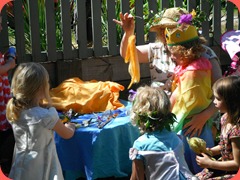
Our Spring festival this year was held at Nature's Nest Community Childcare Centre. We started with some lively spring songs and a game of "Lady Spring", then we all sat down to make some flower garlands.
073 003
 
Our Seasonal festivals are enjoyed by all ages.  Steiner playgroupers past and present along with those who come to the Nest.
 
083
094
091
008

001
 
The story told of a boy who was lead by two sun fairies to lady spring where upon he was given a gift103
….it was more than one it was more than two and when he saw what was in his hand he knew
what to do…….117
122
 
 
And afterwards……..We were lucky enough to share in a beautiful birthday celebration 131


Friday, 31 August 2012

Winter Lantern Festival 2012

Each year we hold a lantern festival at a local camp ground in Moruya Heads.  We gather in the afternoon by a roaring campfire.  Everyone brings something to go into the big soup pot and while we are playing the soup boils away on the fire.  We sup on our shared soup and whatever other treats that may be available.  At dusk we all join together to sing songs and then as darkness falls we are treated to a magical story told by candle light.  We walk a spiral and have our  lanterns lit, then they become our guiding light as we journey on our lantern walk.  
 
 
This year the children made lanterns from recycled jars.  First clean the jars and take off any old labels.  Decorate with tissue paper using simple paper glue.  We also used paper cut outs, done with a craft punch.  Fix some wire on for a handle and use a tealight candle
 
 
Mother Earth appeared in this years story knitting away in her Earthly home 


Here are some pictures of some of the little lovelies with their lanterns..


Wednesday, 18 July 2012

Play


Free Play

Play is the serious work of the child

"Creative Play is like a spring that bubbles up from deep within a child."

It is refreshing and enlivening


The importance of play
Child doesn't have the goals of the adult.  Play is a time when there are no goals beyond the activity itself.
Play helps children weave together all the elements of life as they experience it. It is an outlet for the fullness of their creativity, it is an absolutely critical part of their childhood.
A child playing is:
• Perceiving and exploring situations
• Learning about self and world
• Initiating and exacting possibilities
Play is an experiment into the nature of reality. Play is like a brave adventure into the possibilities and limitations of things. It is the true basis of problem solving.
Adults who are convinced to "teach" children, instead need to set an example in all kinds of activities. They should create appropriate spaces to play and learn and honour the innate capacity for learning that fills the souls of every healthy young child. Young children are born with a wonderful urge to grow and learn. If allowed to set pace, they will work in a tireless and playful way.
Look at toys as "tools" of play - 90% chid, 10% toy. A toy can have an infinite range of uses rather than one purpose.
In children under 3, the play is realistic - they imitate the world around them. They need the involvement of adults to imitate or to play with and are involved with the activities of adults around them. They play repetitively - with joy, each time before emoting onto the next thing and interact enthusiastically with their surroundings, finding each experience fresh and exciting.
In ages 3 to 5 play is stimulated by the toy or object.  Play is stimulated by external events. That is why it is so important that there are toys or objects available to the children that can be transformed by them into anything they wish it to be - multiple uses.  Play is more social - stimulated by each other's ideas and experiences. They begin to negotiate, learn boundaries and limitations, investigate possibilities, build their language and communication skills and hopefully learn to empathise and care for each other. Being involved with domestic activities also stimulates play at this age.
Around or after age 5 - play begins to change - "boredom" - don't know what to do - as if no ideas left. This is when they can be stimulated directly by the adult work. They can be encouraged to join in with the work in the room - cutting up veggies for fruit, tasks such as sewing, weaving or woodwork - always tasks which need to be completed.  It doesn't take long for this phase to pass - hours or days and the transformation from one type of play to another takes place. Now the initial idea comes first, followed by the attempt to find the right materials. They have a mental image of what they want to do or be. Imagination is ready to work again. For children who are getting ready for school it is important that they begin to take responsibility for themselves, their actions and for others. Children have tasks which contribute to the well-being of themselves and of others and of the works around them. They tidy, clean, cook, sweep, decorate, take care of plants and animals, run messages, help the "little ones" and develop skills and co-ordination.
Play is most beneficial for child if it is initiated and directed by the child and accompanied by a play facilitator who is on a path of self-development.
The ability to facilitate this kind of play is not a natural gift, but to be learned. The involvement of the teacher alongside the playing child is to facilitate play through structure of appropriate space and time and with specific materials and toys in which this play can unfold in an undisturbed manner. Play needs facilitation or "guidance".   Guidance does not mean adult initiated or
adult-directed play activity.
To help facilitate / guide children's play, the educator’s role is to:
⁃ set up a well-structured play area
⁃ work with a focus and presence of mind
⁃ observe and listen to children and make an effort to understand children's play
⁃ reduce intervention
⁃ Have trust and empathise with the children
"There are precious places where children can freely develop their own culture and where the creative spirit of childhood can perform its magical transformation… A Steiner kindergarten tries to be such a place, a place where the echoing voices of children at play can still be heard" - Sally Jenkinson

Article by Vanessa Cole

Tuesday, 3 April 2012

Our Autumn Harvest Festival


On Sunday we celebrated our annual harvest festival.   We hold our festival at our local community garden, where as a group we manage a plot.  It is a beautiful space, and an amazing project that is an education and demonstration site for sustainable agricultural and horticultural practices. 

HARVEST
It was golden, golden, golden, as the harvest table was laid


We started with some songs and the story of the Giant Turnip

An egg hunt yielded some welcome surprises

Then we all sat down to find some fairy silk amongst the corn

we even found some star shapes!

 Impromptu corn dollies were born while we waited for our cobs to cook

Garlic Bulb planting

And to finish off, an egg and spoon race (with boiled eggs!)

And Time just seemed to stand still…….

Wednesday, 15 February 2012

Circle Time – An Explanation

Come to the circle where dreams are found,
Take my hand, we’ll dance around,
Ha la, ha la, ha la, ha lo,
Round and round and round we go.

Each morning at Nature’s Nest, staff gather the children from their outside play into inside circle time.  Circle time runs between 5-10 minutes and consists of a range of seasonal songs and rhymes specially designed to include finger/gesture games, movement/circle games, songs in the pentatonic scale, and traditional nursery rhymes.  The songs provide a range of benefits to each child.

These benefits include:
  • Young children have an innate musicality, love of movement and sense of rhythm; circle time nourishes these.
  • Finger and hand movement games develop dexterity and help with brain development.
  • Speech development:  songs and rhymes about everyday jobs and tasks which are accompanied by clear gestures, help the young child to come to language as the actions surround the word with meaning.  These songs also provide strong examples through imitation.
  • Seasonal songs help celebrate and bring awareness to the natural cycle of the year.
  • Singing involves the breath and middle chest region of the body, and helps strengthen and foster healthy development of this area.
  • Songs in the pentatonic scale are very harmonious, providing the child with exposure to beautiful sounds and tones that are pleasing to the ear.
  • Traditional nursery rhymes have a richness of imagery and rhyme which nourish each child.

Songs and music are a great way of engaging children in an activity; we often use songs to assist children during transition times (e.g. hand washing, tidying up, etc.).  You may like to try this at home – “This is the way we wash our hands, wash our hands, wash our hands…before we eat our lunch” etc… to the tune of “Here we go round the Mulberry Bush”.  You may be surprised at how the use of a simple song can turn a ‘chore’ into a fun game!


Kim Edgar-Lane

School Readiness

The main aim in preparing a child for the transition into Kindergarten is to support confidence and independence in the child. There are a number of models that early educators use to assess a child's readiness to make a smooth transition to school. Different modalities focus on different aspects and theories of child development to ascertain a child's level of “readiness.” While some models rely solely on “acquired academic skills” such as counting to ten and name writing, other models assess a child's social competence, such as an ability to get on with others and cope emotionally.
There has been an awakening in recent years by the general community in realising the role of carer givers of young children as educators rather than merely “child minders”. A discussion paper on school readiness issued by the NSW Parenting Centre in 2003 noted the interesting paradox that this realisation has developed into a push on Early childhood services is in the direction of “more structured learning such as pre-reading and pre-numeracy skills to ensure that their children are „ready for school‟ and are not falling behind in a knowledge acquisition race, while researchers and early childhood educators are recognising the importance of less structured aspects of early childhood learning on children‟s readiness for school.”
Full paper available at: www.community.nsw.gov.au/docswr/_assets/.../school_readiness.pdf .
Another website, “The Aussie Childcare Network” states in their document on School Readiness Programs: “There is always a misconception that children should be “taught” in preschool. Yes we should teach the children through their interests and needs but not because they require academic success to begin school. It is our duty to assist a preschool child in transitioning to school through a variety of experiences and making each a confident learner, they have the rest of their lives to be taught.”
Available at http://www.aussiechildcarenetwork.com/school_readiness_program.php
Our aim at Nature's Nest is to support the unfolding child as they move through the developmental phases of childhood. We aim to nurture happy and confident children with a fully developed imagination to form a sturdy platform for life-long learning. To quote Albert Einstein: "Imagination is more important than knowledge." A child who is happy and confident and who has had the opportunity to physically mature has a natural curiosity and yearning to learn all about the “adult world.”
Our daily rhythm incorporates a variety of social settings for children to develop the social confidence, language development, pre-reading, pre-mathematical and the budding independence required for the kindergarten classroom. Following our daily rhythm provides children with the security of knowing what comes next. Our rhythm is “purpose built” to ease children into gaining independence.
Children at Nature's Nest have a lot of opportunities to practice self-management such as independent toileting, putting on their own shoes and hats and accessing their lunch boxes and drink bottles. Older children are encouraged to assist the younger ones, this cultivates a caring attitude towards others; A valuable attribute to bring into any school community. The self-confidence that is gained from a child who has experienced a daily routine in an environment where a caring relationship has been established with others and their surroundings creates a child who is a willing participant in a primary school environment.
Group activities where all children participate, such as circle songs and bread baking, provide children with the opportunity to learn how to contribute in a group. We use simple songs which introduce everyone by name and encourage group harmony. Learning to share with others and negotiating any conflict which may arise can be facilitated with guidance and modelling from the caregivers. The conversations during our activities at the table provide the opportunity for practicing the sharing personal stories and listening to others.
During our free play times, children can experience less formal and more free-flowing relationships. Here, children can explore making new friends, taking turns, sharing, negotiating social conflict and expressing their needs to others, including other children and caregivers. In this setting children are allowed time to resolve conflict. Giving children time to explore how to resolve conflict with others builds confidence and skill in conflict resolution and provides the social negotiation skills required in a classroom or playground.
Children who show an interest are encouraged to join in with the daily living tasks such as, cleaning the table, sweeping, setting the table and handing out the lunchboxes. Sharing the responsibility of daily living tasks fosters an attitude of helpfulness and participation.
At Nature‟s Nest, basic “academic” learning is integrated into all of our daily activities. This kind of natural learning suits the age and developmental stage of the young child. For example, we learn shape recognition by making a game out of finding all the same shaped blocks to pack together at the end of playtime. The simple act of packing away coloured cloths so that the same colours are together on the shelf builds colour awareness. Learning letter recognition is begun by observing the bread tags that each child receives to differentiate their bread on the tray. Finger games and songs incorporate counting, and build vocabulary, while story time encourages an extended period of listening. Our range of daily art/craft activities incorporate the development of fine motor skills while our afternoon games build physical confidence and gross motor development.
The integration of music, art and academic teaching with the daily activities inspires creative and invigorated learners. Our aim school readiness at Nature‟s Nest is to foster confident, emotionally stable children who maintain a natural inquisitiveness and desire to learn.
"Education Is Not the Filling of a Pail, But the Lighting of a Fire" William Butler Yeats (Poet, 1865-

Monday, 16 January 2012

What makes Steiner based childcare different?

What makes a Steiner based centre different from other childcare centres? (Summarised and adapted from Dot Male - The Parent and Child Group Handbook – A Steiner/Waldorf approach)

The main principles underlying Steiner based education stem from the understanding that:
  • In the first seven years children are in the process of growing healthy bodies and developing the skills of every day living.  In order for this process to be carried out fully, the focus at a Steiner day care is on every day activities rather than stimulation of the intellect.
  • Children’s developmental progress varies from one child to another.  In order to accomplish the huge task of gaining control and agility of the physical body they require time, and in a Steiner day care children are not rushed in their development just for the sake of moving to the next stage.  When children are allowed to move at their own pace it sets a strong foundation for later in life.
  • Children need play.  Large amounts of time during the day are set aside for free creative play.  This is vital for all healthy development.
  • Children “soak-in” every thing in their environment.  The child needs to experience the world as beautiful and full of goodness, and to know that we care for our everyday surroundings, for nature and each other.  This is modelled to the children, rather than dictated. The adults/staff involved in a Steiner day care will constantly be striving to be worthy of imitation by the child.  The physical environment at the centre is very carefully attended to, ensuring an atmosphere of inviting warmth.
  • Rhythm and repetition are fundamental qualities in a young child’s life.  They bring security and containment and help to build a strong physical body.  Celebrating cycles and rhythms of the season, the month, the week, the day, the activity helps to create a sense of wonder and reverence.  In a Steiner based setting this is done through seasonal crafts, songs and festivals, and activity in the centre is accompanied with songs, verse and storytelling.
  • Children are nourished by real interactions with other human beings.  At a Steiner based centre the meals are shared, just like a big family. 

Sunday, 8 January 2012

An article written by one of our parents......

All parents who have experienced the hunt for a childcare centre know how extraordinarily difficult it is to find a centre that represents everything you want for your child; a warm, fun environment where they want to be and you feel safe leaving them; a home away from home. 
As a new member of the community I find myself, once again, in search of the Mecca of childcare centres, when unexpectedly and with some confusion, we spot cows. I’m from the city and used to contending with offices, cafes and masses of people, not farm animals. As we pull into the driveway, we see a well-manicured lawn and architrave above the gate; it could be a country guesthouse were it not for the rainbow flags and “Hold my hand” sign, which suggest something more. The wonder continues as we walk through the door. Drawn by the natural colours and calming environment, there’s wooden furniture, a nature table and soft colours draped around the walls. The wooden dolls house, play kitchen, blocks, and trains transport me to an easier, quieter time before mass-production and multimedia. Void of plastics, bright colours and overly decorated walls, the centre welcomes children in and prepares them to create their own environment.
But my opinion doesn’t count for much. My three year old, the more experienced of us in childcare centres, will have the final say. He is welcomed as family and introduced to the children and their thirsty skipping rope snake. It takes time for his curiosity to overcome his shyness but he moves on to play and it is there, on the grass with only a few blocks of wood and a skipping rope, that he finds his Imagination. A little neglected, overlooked by television and DVDs, a hectic family schedule and sporting endeavours, his Imagination blossoms and he becomes his play.
It’s 4 o’clock and we’ve danced, sung, baked and played in the garden. All too quickly, our day ends. We leave, waving goodbye to our new friends, hopeful for the days to come.
Nature’s Nest Community Childcare Centre is a locally managed Steiner education day care centre run by a committee of parents who want children to be children. Nestled amongst a farming community, away from the main streets of Moruya, the hustle and bustle of modern life is left behind and the children can spend their days in the gardens, pretend play or listening to laughing kookaburras on a nature walk.
In keeping with the Waldorf model of imaginative play and imitated activity, singing, craft, play, gardening, care-for-toys and baking all feature in the routines. Routines, called Rhythms, incorporate rhyme and repetition and encourage personal, social, and moral development through creative play in the natural and human world. Daily, weekly, and seasonal rhythms include personal and seasonal celebrations and festivals and allow the children’s songs, stories, and play to represent their lives outside the centre. In conjunction with the Rainbow playgroup and Steiner In The Eurobodalla (SITE) Inc., festivals are celebrated throughout the year and are an opportunity for the centre, children, parents, friends, and family to share stories, songs, and activities with the wider community.
Nature’s Nest has everything you want from a childcare centre, with the added warmth of a home. Whether or not you follow the Steiner philosophy, Nature’s Nest is a beautiful balance of nature and nurture.
“… and so together they travelled over the rainbow bridge
and down the spiral staircase until they came to a big gate.
The child felt a little anxious about leaving his wonderful home,
but with courage in his heart and his Angel beside him,
he went through the gate and
 a little boy was born upon the earth.”
B. Patterson and P. Bradley, Beyond the Rainbow Bridge
Article By Britt Barbic

Saturday, 7 January 2012

About us


Nature’s Nest Community Childcare is an 18 place centre located in a beautiful bush setting.  Our aim is to support families by creating a loving, calm, safe, and warm environment.

Our day follows nature’s rhythm through storytelling, song, painting, bread baking, healthy seasonal food and lots of play.

Based on Rudolf Steiner’s principals of early childhood our curriculum is rich with early learning experiences that lay the foundations for class room learning including pre literacy skills, social abilities, problem solving,
and critical thinking.

Aust Govt Childcare benefit available
Enrolment or further information
please contact our centre on
44745746

Our Mission

Missions and Visions
SITE (Steiner in the Eurobodalla) mission: To foster and administer not-for-profit activities and ventures in the Eurobodalla Shire that incorporate a Steiner Philosophy.

Nature’s Nest mission: Our vision is to create a loving, safe, secure and warm environment, which is an extension of the family home.  We aim to nurture the freedoms of childhood and support family well being by offering a high quality and creative childcare option.
This will be achieved by
  • Creating a natural setting within the centre which is warm, gentle, home-like, uncluttered, and non commercial.  Toys will be simple and hand-made from natural materials, encouraging creative play.
  • Allowing the opportunity for authentic interactions with the world around us. Through nature walks, water play, sand play, and baking bread.
  • Giving children the freedom and space to play.
  • Fostering learning by modelling, through the use of storytelling, songs and circle games that follow a regular seasonal and daily rhythm and routine.
  • Providing foundations for problem solving, critical thinking and life long learning through encouraging the natural curiosity, creativity and wonderment of the child. 
  • Offering structured daily routines that follow a seasonal and daily rhythm that take into account the natural stages, development and mood of each child.
  • Showing reverence and respect for the individuality of each child, by recognising the different temperament and changing needs of each child and finding positive ways to enhance their individual strengths.
  • Nurturing positive attitudes towards each other and our environment through showing mutual respect for one another and reverence for the natural world.
  • Encouraging well being through good nutrition and healthy habits.   Promoting wholesome and seasonal foods and using joyful songs and rhymes to make healthy habits such as washing hands and tidying up a positive experience.
  • Using Rudolf Steiner’s principals of early childhood as a guide.

History

Nature’s Nest was born out of the growing community of parents in our shire who value the Rudolf Steiner philosophy of early childhood education.  It is truly a community organisation which has had input over time from many different families from all over our shire.
The organisation that manages the centre, Steiner In The Eurobodalla (SITE) (formally ESEAI) first began meeting about 17 years ago when many of the parents had children enrolled in the child care centre, which was then Country Cottage child care.  From these meetings the Eurobodalla Steiner Playgroups were gradually formed.  SITE became an incorporated body and continued to meet and organise various activities over the years that enabled our community to practice and learn more about Steiner Education.

Nature’s Nest aims to cater for the needs of families by providing a creative and appropriate childcare option, a centre that houses our playgroups and facility in which to run parent education workshops, craft workshops and seasonal festivals.  In short the centre is not only for those that are enrolled in the day care sessions. Nature’s Nest is a community run, not-for-profit centre.

“The preschool years, the kindergarten years, (the years before formal
schooling) are the most important of all in the education of the child.”
“It is absolutely essential that before we begin to think, before we so
much as begin to set our thinking in motion, we experience the condition
of wonder.”
Rudolf Steiner