
Tuesday, 17 December 2013
Craft Workshop October 2013

Thursday, 27 September 2012
Spring Festival 2012
Our Spring festival this year was held at Nature's Nest Community Childcare Centre. We started with some lively spring songs and a game of "Lady Spring", then we all sat down to make some flower garlands.


Our Seasonal festivals are enjoyed by all ages. Steiner playgroupers past and present along with those who come to the Nest.


The story told of a boy who was lead by two sun fairies to lady spring where upon he was given a gift

….it was more than one it was more than two and when he saw what was in his hand he knew
what to do…….


And afterwards……..We were lucky enough to share in a beautiful birthday celebration 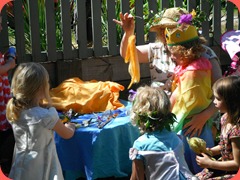

Friday, 31 August 2012
Winter Lantern Festival 2012
Each year we hold a lantern festival at a local camp ground in Moruya Heads. We gather in the afternoon by a roaring campfire. Everyone brings something to go into the big soup pot and while we are playing the soup boils away on the fire. We sup on our shared soup and whatever other treats that may be available. At dusk we all join together to sing songs and then as darkness falls we are treated to a magical story told by candle light. We walk a spiral and have our lanterns lit, then they become our guiding light as we journey on our lantern walk.

 This year the children made lanterns from recycled jars. First clean the jars and take off any old labels. Decorate with tissue paper using simple paper glue. We also used paper cut outs, done with a craft punch. Fix some wire on for a handle and use a tealight candle
Mother Earth appeared in this years story knitting away in her Earthly home

Here are some pictures of some of the little lovelies with their lanterns..


Wednesday, 18 July 2012
Play
Free Play
Play
is the serious work of the child
"Creative
Play is like a spring that bubbles up from deep within a child."
It is
refreshing and enlivening

The importance of play
Child
doesn't have the goals of the adult. Play
is a time when there are no goals beyond the activity itself.
Play
helps children weave together all the elements of life as they experience it.
It is an outlet for the fullness of their creativity, it is an absolutely
critical part of their childhood.
A
child playing is:
•
Perceiving and exploring situations
• Learning
about self and world
• Initiating
and exacting possibilities
Play
is an experiment into the nature of reality. Play is like a brave adventure
into the possibilities and limitations of things. It is the true basis of
problem solving.
Adults
who are convinced to "teach" children, instead need to set an
example in all kinds of activities. They should create appropriate spaces to play and
learn and honour the innate capacity for learning that fills the souls of
every healthy young child. Young children are born with a wonderful urge to
grow and learn. If allowed to set pace, they will work in a tireless and
playful way.
Look
at toys as "tools" of play - 90% chid, 10% toy. A toy can have an infinite range of uses rather than one purpose.
In
children under 3, the play is realistic - they imitate the world around them.
They need the involvement of adults to imitate or to play with and are involved
with the activities of adults around them. They play repetitively - with joy,
each time before emoting onto the next thing and interact enthusiastically with
their surroundings, finding each experience fresh and exciting.
In
ages 3 to 5 play is stimulated by the toy or object. Play is stimulated by external events. That is
why it is so important that there are toys or objects available to the children
that can be transformed by them into anything they wish it to be - multiple uses.
Play is more social - stimulated by each
other's ideas and experiences. They begin to negotiate, learn boundaries and
limitations, investigate possibilities, build their language and communication
skills and hopefully learn to empathise and care for each other. Being involved
with domestic activities also stimulates play at this age.
Around
or after age 5 - play begins to change - "boredom" - don't know what
to do - as if no ideas left. This is when they can be stimulated directly by
the adult work. They can be encouraged to join in with the work in the room -
cutting up veggies
for fruit, tasks such as sewing, weaving or woodwork - always tasks which need
to be completed. It doesn't take long
for this phase to pass - hours or days and the transformation from one type of
play to another takes place. Now the initial idea comes first, followed by the
attempt to find the right materials. They have a mental image of what they want
to do or be. Imagination is ready to work again. For children who are getting ready
for school it is important that they begin to take responsibility for
themselves, their actions and for others. Children have tasks which contribute
to the well-being of themselves and of others and of the works around them.
They tidy, clean, cook, sweep, decorate, take care of plants and animals, run
messages, help the "little ones" and develop skills and co-ordination.
Play
is most beneficial for child if it is initiated and directed by the child and
accompanied by a play facilitator who is on a path of self-development.
The
ability to facilitate this kind of play is not a natural gift, but to be
learned. The involvement of the teacher alongside the playing child is to facilitate
play through structure of appropriate space and time and with specific materials
and toys in which this play can unfold in an undisturbed manner. Play needs
facilitation or "guidance". Guidance does not mean adult initiated or
adult-directed
play activity.
To
help facilitate / guide children's play, the educator’s role is to:
⁃ set up a well-structured play area
⁃ work with a focus and presence of mind
⁃ observe and listen to children and make an effort
to understand children's play
⁃ reduce intervention
⁃ Have trust and empathise with the children
"There
are precious places where children can freely develop their own culture and
where the creative spirit of childhood can perform its magical transformation…
A Steiner kindergarten tries to be such a place, a place where the echoing
voices of children at play can still be heard" - Sally Jenkinson
Article by Vanessa Cole
Tuesday, 3 April 2012
Our Autumn Harvest Festival
On Sunday we celebrated our annual harvest
festival. We hold our festival at our
local community garden, where as a group we manage a plot. It is a beautiful space, and an amazing
project that is an education and demonstration site for sustainable
agricultural and horticultural practices.
Read more at http://sageproject.org.au/
HARVEST

It was golden, golden, golden, as the
harvest table was laid


We started with some songs and the story
of the Giant Turnip

An egg hunt yielded some welcome surprises

Then we all sat down to find some fairy silk amongst
the corn


Impromptu corn dollies were born while we
waited for our cobs to cook

Garlic Bulb planting


And Time just seemed to stand still…….
Thursday, 22 March 2012
Pasta Making at the Southeast Harvest Festival
Last
weekend we attended the Southeast Harvest Festival in our home town of Moruya. It was a muddy start to the day, but a few
tarps down and a roll of carpet and we had made our little home for the
day.
 |
| Rolling, rolling roll the dough.. |
We
set up our children’s pasta making table and away we went. Children flocked to the table and enjoyed
rolling out the pasta dough while they waited for their turn on the
machine. It was as much a pleasure to
watch as each ball of dough was turned through the machine with the rhythmic
whirling of the handle, a joy that could be experienced from the smallest of
hands. A few rolls through and…. voila!
Fresh pasta ready to be cooked on the spot.
 |
| A bowl of pasta ready to be cooked |
One
minute in the boiling pot and the pasta was ready to be topped with fresh home
grown herb and garlic butter, South Coast Cheese and fresh cherry tomatoes
picked from my home garden.
We
rolled and rolled all day long until the last of the dough was gone.

Many
of the parents were surprised about how easy it was to make pasta with
children. I thought that I would include
the pasta recipe’s we used on the day so that you can try it at home:
Pasta Dough
number 1:
Kylies Duck Egg pasta:
Ingredients:
Duck eggs
Organic
Durham wheat flour ( you can use normal wheat flour, but Durham wheat is much
nicer and easier to manipulate)
Method: Put
required amount of flour into a mixing bowl.
Add enough eggs to make smooth dough.
The general rule is one egg to 100gms of flour, but you may need to add
flour if it is too wet or a dash of water if it is too dry. Knead the dough until smooth.
The duck
eggs made beautiful rich pasta with a tasty flavour that was easy to
manipulate.

Pasta dough
number 2:
Melschooks Pasta
Ingredients:
Fresh chook
eggs
Organic
Durham wheat flour
Method: As
above only using chook eggs instead of duck eggs.
Pasta dough
number 3:
Jayla’s Gluten free pasta
 |
| There's Jayla making the gluten free dough while I worked the "Melschooks" dough |
Ingredients:
Eggs
Gluten free
flour mix
Method: As
above. When rolling the gluten free
pasta, we found that rolling it just a little thicker than the wheat dough worked
best.
We used a
hand operated machine that can be purchased easily from a kitchen ware
store. We took pieces of dough about the
size of a ping pong ball- not too big or it is too hard for the children to
manage the dough. Roll out the dough with
a rolling pin, adding sprinkles of flour if it is too sticky. Put the machine on the widest setting and
roll through, sprinkle flour on both sides and fold in half. Repeat this at least five times. Then you are ready to make the dough thinner,
set the dial a little thinner each time you roll the dough through the machine,
adding flour as you go. You don’t want
the dough to be too sticky or it will be hard to cut into strips. Too dry and it will break apart. If you roll it too thin for gluten free it
will break apart. When you have made the
dough thin enough to your satisfaction you can put it through the cutting part
in your machine; we used the fettuccini setting mostly, as it is the easiest to
make and cook.
Put the
fresh pasta straight into a boiling pot for 1 minute or 2- not too long or it
will melt away into sludge.
You will be
surprised how lovely fresh pasta is on its own or with a simple accompaniment of
fresh tomatoes and cheese or just a dash of olive oil and crushed garlic. It is
also a nutritious meal for children providing a great amount of protein and
nutrients from the eggs and the complex carbohydrates of whole Durham wheat. Besides the fact that they love the taste!
We would
like to thank the Southeast Harvest Festival for having Nature’s Nest, and Harris Scarfe Moruya for
the donation of the pasta machine, it will certainly become a well- loved
activity at Nature’s Nest for years to come I am sure!
By Mel Turner
Tuesday, 13 March 2012
A Great New Parenting Website
www.mamatierra.com.au is a new website, just
launched to support parents in raising holistically healthy children from birth
and beyond. Mama Tierra has hand-selected hundreds of eco-friendly products
including cloth nappies, organic skincare, BPA-free baby bottles, organic and
bamboo clothing, toys and bedding, books on conscious parenting and more. On
the Mama Tierra site, there is also a natural parenting forum, a growing
directory of child specialists and health practitioners and blogs on topics
relating to children's holistic health and wellbeing. It’s definitely worth
checking out! A hardcopy catalogue will be available at Nature’s Nest for you
to view.
Subscribe to:
Posts (Atom)